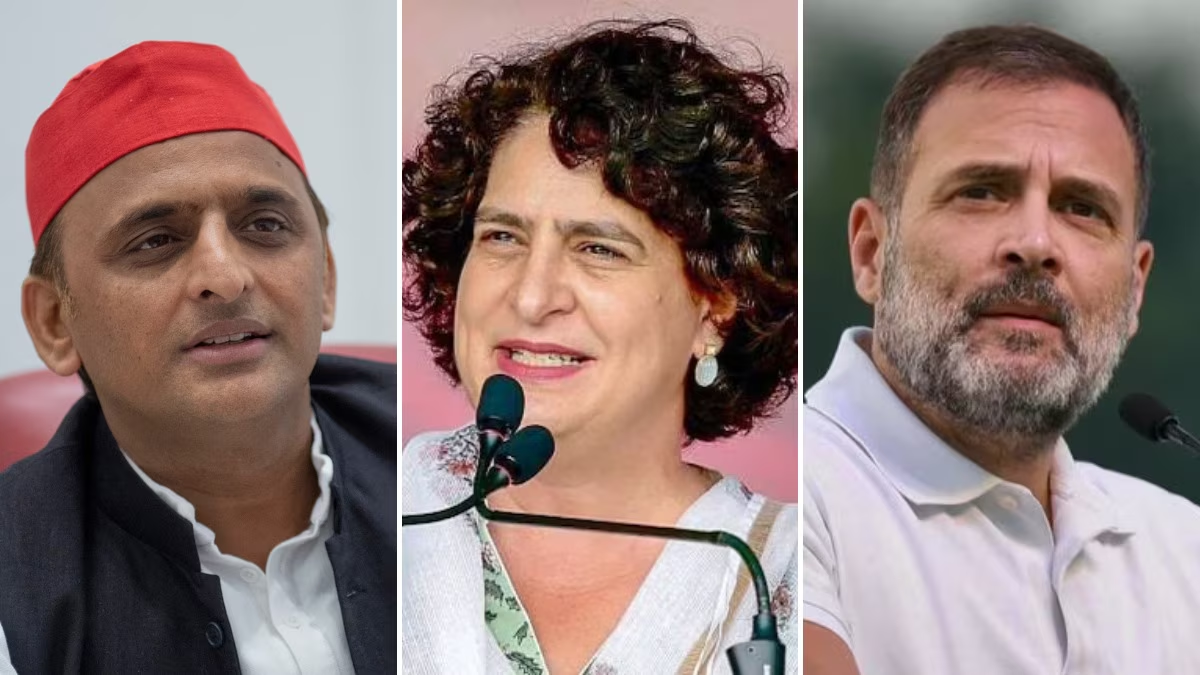
Lucknow: Questions are emerging over Congress leader Priyanka Gandhi Vadra’s role in shaping the party’s strategy in Uttar Pradesh ahead of the 2027 Assembly elections, as differences over seat-sharing and political positioning threaten to complicate its relationship with the Samajwadi Party (SP).
Although both parties are part of the INDIA opposition bloc, recent statements by Congress leaders have reportedly raised concerns within the alliance about the distribution of seats and the Congress’s electoral ambitions in the state.

The Congress has made organisational changes in Uttar Pradesh, appointing Rajendra Pal Gautam as state in-charge, Saharanpur MP Imran Masood as working president and Aradhana Mishra ‘Mona’ as state president. The appointments have been viewed as an effort to strengthen the party’s outreach among different social groups.
However, Gautam’s reported assertion that the Congress would not settle for fewer than half the Assembly seats, along with Masood’s criticism of SP leader Akhilesh Yadav’s strategy and seat-sharing approach, has fuelled speculation about the future of the alliance.
The debate has also revived questions about the relative electoral strength of the two parties. In the 2024 Lok Sabha elections, the SP won 37 seats in Uttar Pradesh, while the Congress secured six of the 17 seats it contested under the alliance arrangement.
Previous Elections Shape Seat-Sharing Debate
The two parties have a complicated history of electoral cooperation. In the 2017 Uttar Pradesh Assembly elections, the SP and Congress contested together but suffered a major defeat, with the BJP securing a decisive majority.
In the 2022 Assembly elections, the Congress contested independently across the state’s 403 constituencies. The party won two seats and secured approximately 2.33 per cent of the vote, underlining the challenges it faced in rebuilding its state-level support base.
These results have become part of the current debate over the Congress’s bargaining position and its ability to expand its political presence without weakening its relationship with the SP.

Akhilesh Yadav has largely avoided a direct confrontation over the reported remarks, while other SP leaders have responded to the Congress’s position. This restraint could help prevent public disagreements from escalating, although the parties’ eventual approach to seat-sharing remains uncertain.
Priyanka Gandhi’s Role Under Scrutiny
Priyanka Gandhi Vadra’s influence over the Congress’s Uttar Pradesh strategy has drawn renewed attention as the party seeks to strengthen its organisation ahead of the next Assembly elections. The central question is whether the Congress will prioritise rebuilding its independent support base or continue to rely on cooperation with regional parties to challenge the BJP.
For the SP, protecting its position as a major political force in Uttar Pradesh is likely to remain a central consideration during negotiations. For the Congress, securing a larger share of seats could be part of its effort to revive the party in a state where its electoral influence has declined significantly over the years.
The challenge for both parties will be to reconcile their organisational ambitions with the practical requirements of an electoral alliance. Public disagreements over seat-sharing could complicate coordination, candidate selection and campaign planning before the 2027 polls.
With the BJP remaining a major contender in the state, the opposition’s ability to maintain cooperation could become an important factor in the electoral contest. Whether Priyanka Gandhi and the Congress leadership can balance the party’s expansion plans with the SP’s interests will become clearer as negotiations and political preparations gather momentum.
For now, the relationship between the two parties remains a key point of discussion in Uttar Pradesh politics, with the eventual seat-sharing formula likely to provide a clearer indication of the alliance’s direction.